
Contractors don’t complain to vendors. They complain to each other.
We spent weeks in the places where HVAC techs, plumbers, and electricians talk freely. Not at trade shows. Not on vendor webinars. On Reddit, where no one is selling anything and the language is raw. This is a home services AI automation opportunity hiding in plain sight.
Five subreddits. 154 posts. 2,477 comments. We extracted, deduplicated, and categorized every operational pain point. The result: 503 validated complaints from people who do this work every day.
No vendor marketing. No survey bias. No “on a scale of 1-10, how satisfied are you?” Just contractors telling other contractors what’s broken.
Here’s what they said. And what AI automation can actually fix.
What Contractors Are Actually Saying
The Data
We analyzed five communities: r/HVAC, r/electricians, r/Plumbing, r/Housecallpro, and r/msp. Using AI-powered extraction, we pulled 814 raw pain points, removed duplicates, and validated 503 unique operational complaints. Then we categorized them by severity and business impact.
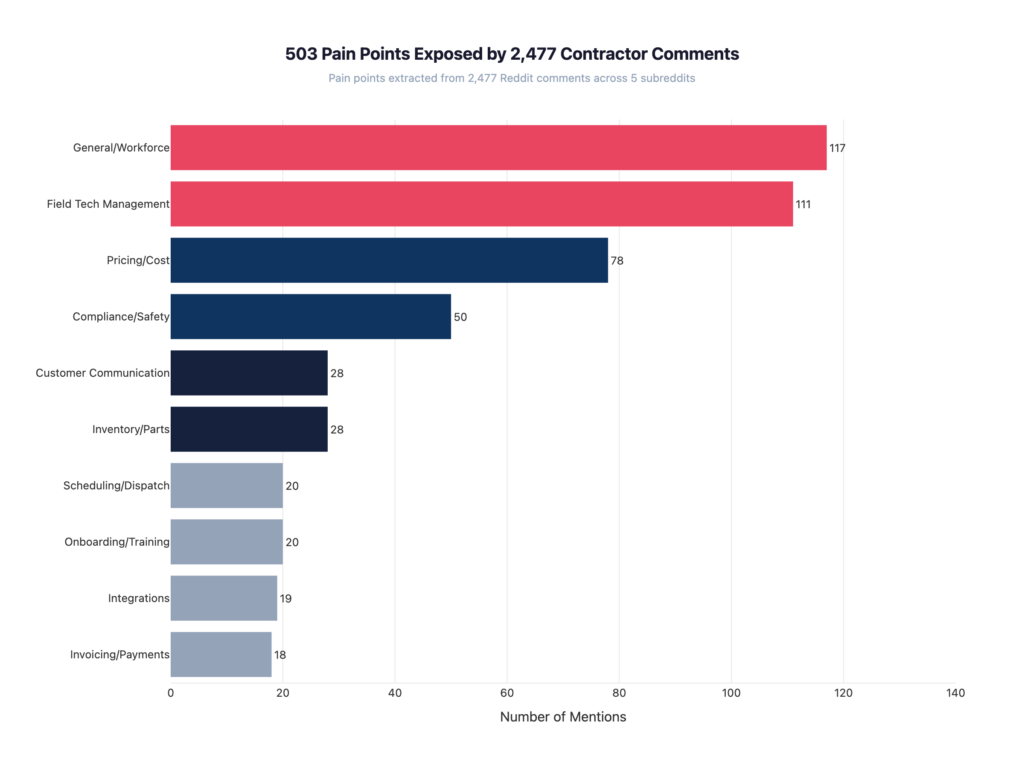
The top categories tell a clear story:
- General/Workforce Issues: 117 mentions (23%). Burnout, hiring, training gaps.
- Field Tech Management: 111 mentions (22%). Mobile app failures, estimate friction, paperwork nightmares.
- Pricing/Cost Sensitivity: 78 mentions (15.5%). Software that costs too much for what gets used.
- Compliance/Safety: 50 mentions (10%). Licensing headaches across state lines.
- Customer Communication: 28 mentions (5.6%). Dropped follow-ups, missed review opportunities.
- Scheduling/Dispatch: 20 mentions (4%). Manual assignment, cancellation chaos.
92% of these pain points scored moderate-to-high severity. This isn’t idle complaining on the internet. These are operational problems costing real money every week.
What They’re Really Saying
“tbh half the software out there is just expensive bloatware you won’t use” Contractor on r/HVAC
“Kicking Housecall Pro to the curb after two instances recently where they made changes to my account/billing without consent” Contractor on r/Housecallpro
“Takes 3x as long to put together a damn estimate” Contractor on r/HVAC, describing ServiceTitan’s mobile experience
“managing estimates, invoices, and scheduling across different tools eventually gets messy” Contractor on r/Plumbing
Look at those quotes again. Not one contractor is asking for a new platform. They’re asking for their existing tools to work. To talk to each other. To stop wasting their time.
The most common pain isn’t “bad software.” It’s software that doesn’t connect. Contractors running QuickBooks in one tab, their FSM in another, and a spreadsheet to reconcile the two. That’s the real problem.
For context: Housecall Pro announced platform upgrades in February 2026, and ServiceTitan continues investing in its Dispatch Pro module. These vendors are working on the problem. But contractor frustration persists because the gap between “feature exists” and “feature works for my business” is where most companies live.
Why This Matters Now
Three forces are converging. None of them wait.
Private equity is buying your competitors.
Gryphon Investors added to their Southern Home Services platform in March 2026, acquiring Dunn’s HVAC and Nick’s Plumbing in Houston. McKinsey’s 2026 analysis puts the US home services market at roughly $700 billion, with 80% still held by independents and projected growth to $802 billion by 2030. The money is flowing in. PE-backed consolidators bring deeper pockets, better systems, and faster response times. Companies that don’t modernize operations become acquisition targets at discount multiples.
Your customers already went digital.
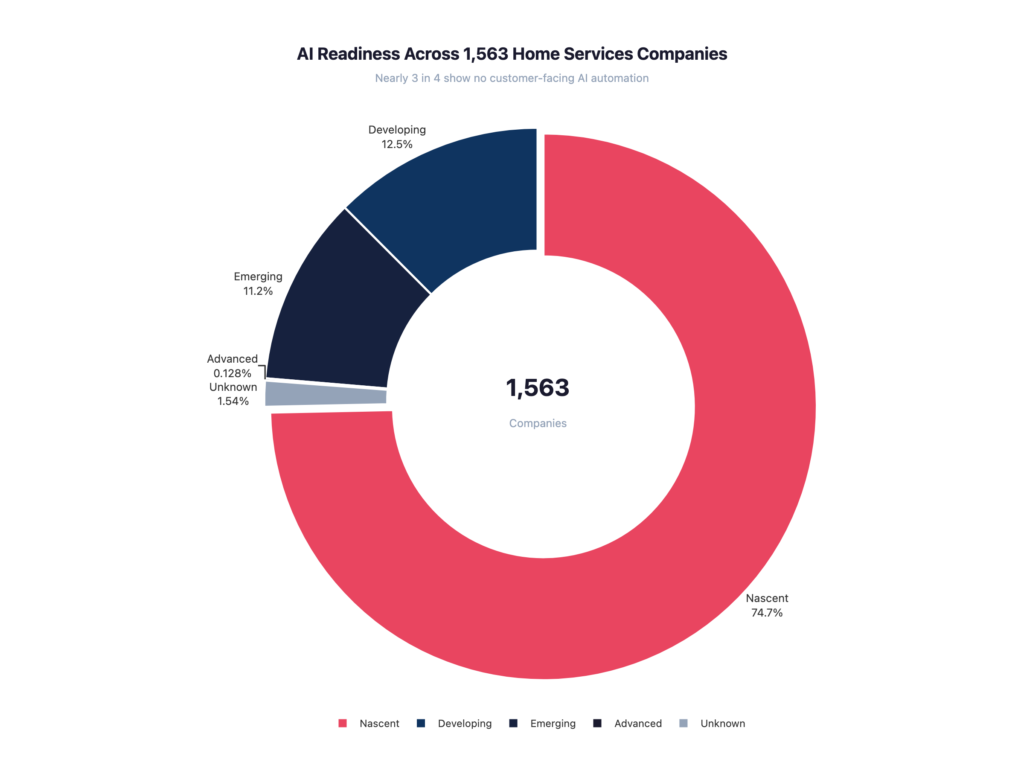
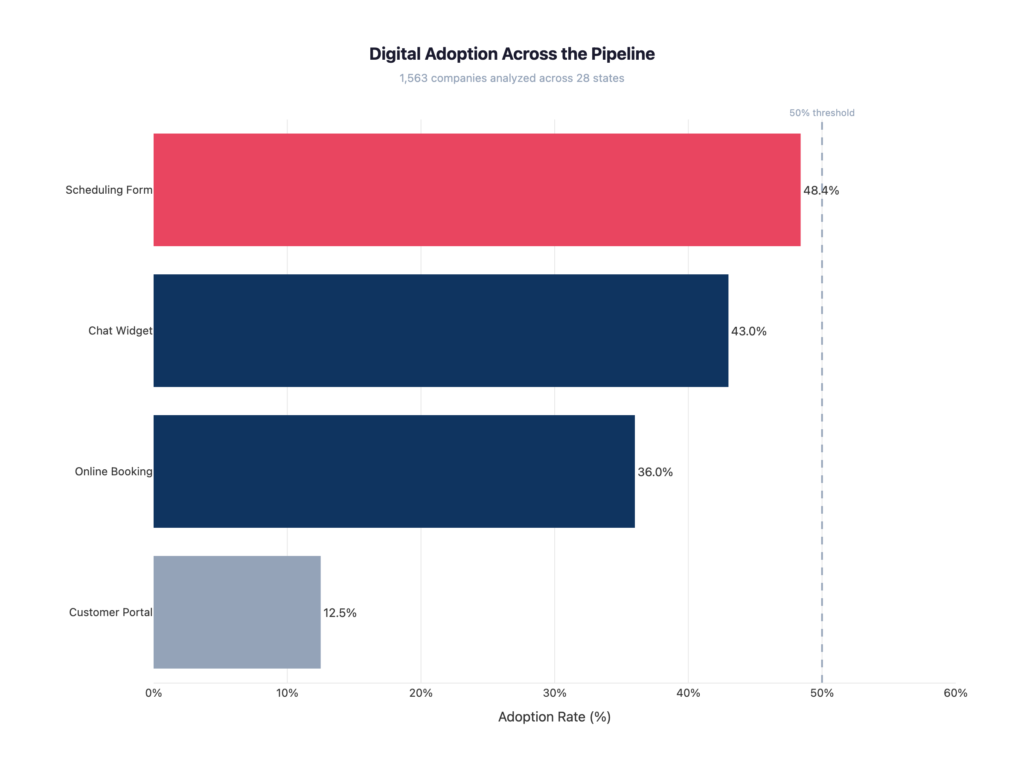
The Scorpion 2026 Industry Report (surveying 2,000 homeowners) found 83% now search online for home services. 22% use AI tools like ChatGPT to research contractors before calling. And 80% of business leaders are unsure how to even appear in AI-driven search results. Our analysis of 1,563 companies across 18 states found that 75% show no customer-facing AI automation, even the 287 running ServiceTitan and the 93 on Housecall Pro. ServiceTitan’s own research found only 12% of contractors have embedded AI into daily operations. 44% cite training as the barrier. 44% cite complexity. The features exist inside these platforms. The implementation doesn’t. Many companies have basic digital tools like scheduling forms, chat widgets, even online booking, but no intelligence layer connecting them. They have the foundation. They just haven’t built on it yet.
The first company to respond gets the job.
78% of customers hire the first company to respond (Lead Connect study, cited across Convoso, Hatch, and Podium). Not the cheapest. Not the best-reviewed. The first. Research from Valve+Meter’s study of 466 home services companies found that 40% never respond at all, and 63% never attempt a callback. Harvard Business Review found the average B2B response time is 42 hours. Nearly 9 in 10 companies take more than 5 minutes to reply (Hatch, 132,188 campaigns).
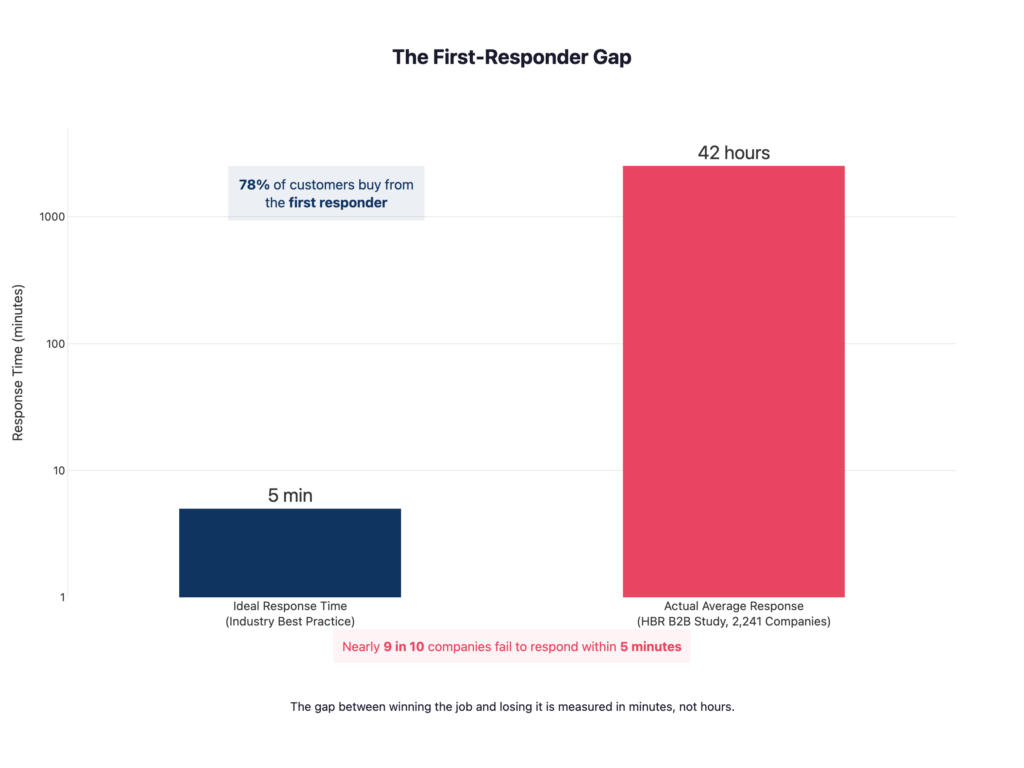
That’s not a technology problem. That’s a math problem. Every missed call is a lost job. Every hour of delay is a competitor’s opportunity, and home services AI automation isn’t a future concept; it’s already solving these problems.
The window to move first is open. Here’s what moving first looks like.
Solution Spotlights
Four categories of AI automation. Each one starts with a real pain point from the Reddit data, a question worth asking yourself, and a clear path forward. No jargon. No rip-and-replace. Just targeted fixes that connect to your existing tools.
Spotlight 1: Speed-to-Lead
The Pain
“78% of customers buy from the first company to respond.”
That’s not our number. That’s an industry benchmark confirmed across multiple studies (Lead Connect, via Convoso and LeanData). Pair it with this: nearly 9 in 10 companies take more than 5 minutes to reply, based on Hatch’s analysis of 132,188 campaigns. The 5-minute cliff is real. Leads contacted within 5 minutes are 21x more likely to convert (InsideSales.com / LeadResponseManagement.org). Wait 30 minutes and your odds of even making contact drop by 100x.
Contractors on Reddit described scheduling and dispatch pain in 20 separate threads. Customer communication gaps showed up in 28 more. The root cause is the same: when a call comes in after hours, it goes to voicemail. And voicemail goes nowhere.
The Question
How many calls went to voicemail last month? What was each one worth?
The Solution
An after-hours SMS auto-response. Within 60 seconds: “Got your message. A tech will call you back within 15 minutes.” AI classifies the intent: emergency calls get routed to on-call. Routine requests get scheduled for callback. Every lead gets captured in your CRM automatically.
For companies ready for a premium tier, AI voice agents (tools like Vapi or Bland.ai) can handle the initial qualification call, answer basic questions, and book appointments directly into your calendar. We implement and configure these tools to work with your existing phone system. We don’t build the voice platform. We make it work with everything else you have.
The Tiers
| Tier | What You Get | Who Does It |
|---|---|---|
| DIY | Set up CallRail + missed call text-back (we provide the playbook) | You |
| Guided | We configure your VoIP + SMS auto-response + CRM logging | We build, you operate |
| Done-for-you | Full speed-to-lead engine: AI voice + SMS + routing + CRM + reporting | We build and manage |
The ROI
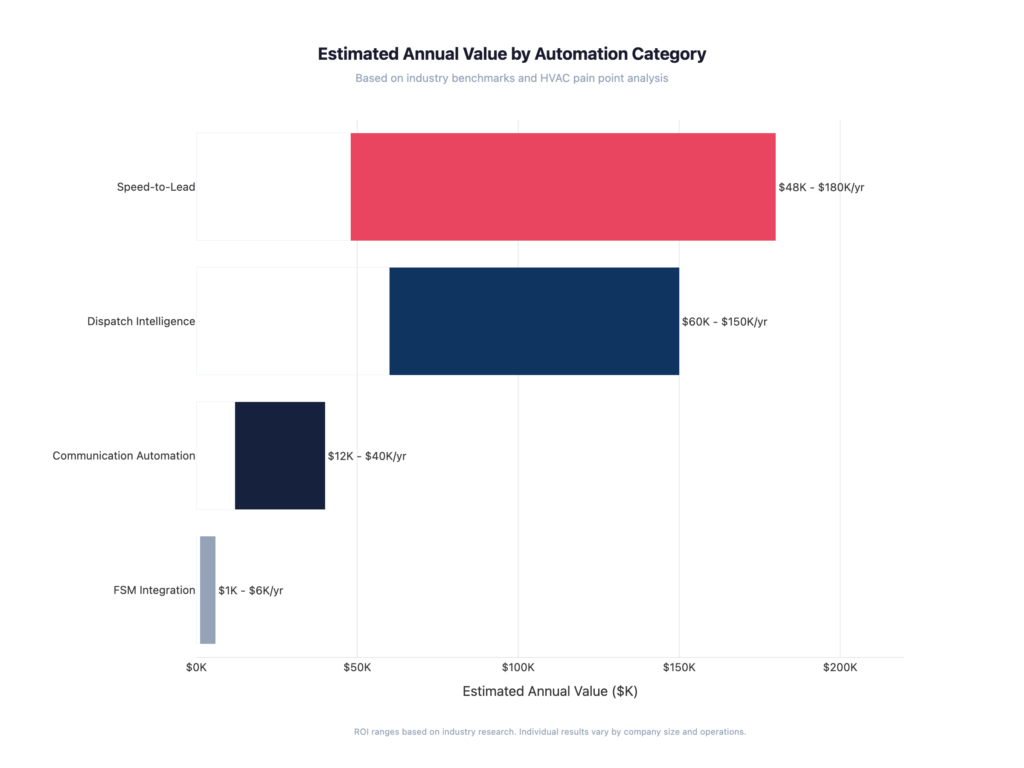
Our pipeline analysis of 995 HVAC companies informed the math behind these estimates: $48K to $180K per year in recovered revenue for a typical operation. Recover 5 to 15 missed leads per month, multiply by your average ticket ($800 to $1,500), and annualize. Velocify research found a 391% conversion boost for first-minute contact. Even conservative estimates show dramatic improvement when response time drops from hours to minutes. [Source: HAIBRID pipeline analysis (995 HVAC companies), Velocify first-minute conversion study, InsideSales.com lead response research]
Spotlight 2: Dispatch Intelligence
The Pain
“Takes 3x as long to put together a damn estimate” Contractor on r/HVAC
Manual tech-to-job assignment is universal. Even on platforms that advertise AI dispatch. We reviewed 12 FSM platforms. Only 2 have real AI-powered dispatch capabilities. The rest? Drag-and-drop boards where your dispatcher makes every decision based on gut feel and a whiteboard.
Then there’s the cancellation problem. When a job drops at 2pm, your dispatcher scrambles to find the next best assignment while the phone keeps ringing. Every unoptimized reassignment costs drive time, tech downtime, and customer frustration.
The Question
When a job cancels at 2pm, how long does it take your dispatcher to find the next best assignment?
The Solution
This is not about replacing your dispatch system. It’s about adding an intelligence layer on top of it.
A morning dispatch briefing: AI analyzes today’s schedule, flags gaps, suggests optimizations. “Move Job #4521 to Tech B. Saves 45 minutes of drive time.” Tech-to-job matching that considers skills, certifications, proximity, and workload. When a cancellation hits, the system immediately recommends reassignment and posts it to your dispatcher’s Slack or phone.
Your dispatcher still makes the final call. The AI handles the analysis. Think of it as giving your best dispatcher a research assistant who never takes a break.
The Tiers
| Tier | What You Get | Who Does It |
|---|---|---|
| DIY | Scheduling audit framework (we provide the template) | You review your own data |
| Guided | We analyze your dispatch data and deliver an optimization report | We diagnose, you implement |
| Done-for-you | Dispatch Intelligence Briefing: daily AI schedule analysis + Slack recommendations | We build, integrate, and monitor |
The ROI
Industry benchmarks suggest $60K to $150K per year from dispatch optimization, driven by 20 to 25% route efficiency gains (McKinsey 2024 analysis of AI-driven scheduling) and reduced dead time between jobs. ServiceTitan’s Dispatch Pro case study with A1 Garage Door showed a doubled tech-to-dispatcher ratio (10:1 to 20:1), 150 techs added without adding dispatchers, and lead conversion jumping from 9.5% to 12%. These are industry benchmarks, not HBC client results. We frame dispatch as a consulting diagnostic. We analyze your data, find the inefficiencies, and build the intelligence layer. We are not a platform vendor competing with your FSM. [Source: McKinsey fleet optimization analysis, ServiceTitan Dispatch Pro / A1 Garage Door case study]
Spotlight 3: Customer Communication
The Pain
“managing estimates, invoices, and scheduling across different tools eventually gets messy” Contractor on r/Plumbing
28 pain points about customer communication. 5.6% of the total. Sounds small until you realize this is where most companies drop the ball after the job is done. The tech finishes, drives away, and nothing happens. No follow-up text. No satisfaction check. No review request. The job is done but the relationship isn’t.
The Question
After your tech finishes a job, what happens next? If the answer is “nothing,” you’re leaving money and reputation on the table.
The Solution
A communication engine that runs automatically from booking to review.
Appointment confirmation and reminder sequences (SMS + email). “Tech on the way” notification with a real ETA. Post-job satisfaction check: an automated text asking “How was your experience? Reply 1 to 5.” Customers who reply 4 or 5 get directed to your Google review page. Customers who reply 1 to 3 get routed to a manager for a personal follow-up before the bad review hits. Quote follow-up sequences: 48 hours, 1 week, 2 weeks. Automated reminders for estimates that haven’t been accepted.
Every component here runs on proven automation patterns. Multi-step sequences, AI analysis, conditional branching. This is where our production systems map most directly to home services needs.
The Tiers
| Tier | What You Get | Who Does It |
|---|---|---|
| DIY | Communication workflow templates + setup guide | You configure in your FSM |
| Guided | We design your customer journey map and configure the automations | We design, you approve |
| Done-for-you | Full communication automation: lifecycle + review engine + quote follow-up | We build, test, and optimize |
The ROI
Review automation: $12K to $36K per year based on review-driven customer acquisition. 15 to 25% increase in review volume translates directly to better Google rankings and more inbound leads. Appointment reminders: $15K to $40K per year from reduced no-shows and cancellations. A 20%+ reduction in missed appointments at $350 average ticket adds up fast. [Source: HVAC pain point tier mapping, communication automation industry data]
Spotlight 4: FSM Integration
The Pain
“I just can’t be bothered to spend the time to switch” Contractor on r/HVAC
“tbh half the software out there is just expensive bloatware you won’t use” Contractor on r/HVAC
35.7% of the 1,563 companies in our pipeline database are still running QuickBooks + spreadsheets + pen and paper. Another large segment has FSM platforms but uses them at 40 to 60% capacity. And across the board, QuickBooks sync drops approximately 2% of line items. Jobber users report it. ServiceTitan users report it. It’s a known problem that everyone works around manually.
The Question
How many times this week did someone on your team copy data from one system to another? That’s your integration tax.
The Solution
Start with an integration audit. Map every tool, every data flow, every manual copy-paste step. Then build the middleware layer that connects your existing tools without replacing any of them. Your FSM talks to QuickBooks. QuickBooks talks to your scheduling. Your CRM gets updated automatically. No one copies numbers between screens.
We’re platform-agnostic. We don’t care if you use ServiceTitan, Housecall Pro, Jobber, or QuickBooks and a whiteboard. Our job is to make whatever you have work better together.
For companies paying $100 to $500 per month for Zapier to hold their tools together, we can rebuild those automations on self-hosted infrastructure and cut that cost by 60 to 80%. That alone often pays for the engagement.
The Tiers
| Tier | What You Get | Who Does It |
|---|---|---|
| DIY | Integration audit template + getting-started guide | You map your own systems |
| Guided | We audit your tool stack and deliver an integration blueprint | We diagnose, you implement |
| Done-for-you | Full middleware build: all tools connected, data flowing, monitoring in place | We build, deploy, and maintain |
The ROI
Integration efficiency gains vary by complexity. Zapier-to-middleware migration saves $1,200 to $6,000 per year in platform costs alone. Beyond cost savings, eliminating manual data entry typically recovers 5 to 10 hours per week for a 10-person operation. At $35 per hour, that’s $9,100 to $18,200 per year in labor efficiency. [Source: HBC integration architecture analysis, middleware migration cost data]
Three Segments, Three Next Steps
You’ve read the data. You’ve seen the solutions. Now the question is: which one sounds like you?
If You’re Leaving Your FSM Platform
“Kicking Housecall Pro to the curb.”
Sound familiar? If you’re evaluating a switch, you need a migration plan, not another sales pitch from another vendor. Before you commit to a new platform, get a clear picture of what you’re actually using, what you’re paying for, and what the migration will cost.
Your next step: Book a 30-minute ops review. We’ll assess whether to migrate, optimize, or add an intelligence layer to what you have. No pitch. No commitment. Just a diagnostic conversation about your operations.
If You’re Running QuickBooks + Spreadsheets + Paper
You’ve built a multi-million-dollar business on determination and duct tape. Respect. But here’s the math: the next few million require systems that talk to each other. When your competitor responds to a missed call in 60 seconds and 40% of companies never respond at all, determination isn’t enough.
Your next step: Take the Cliff Index assessment to see where you stand. Five questions. Two minutes. See how your company compares to the 1,563 we analyzed.
If You’re Paying for Enterprise Software You Barely Use
You’re spending $30K per year on a platform you use at 40 to 60% capacity. That’s not a technology problem. It’s an implementation problem. And no vendor is going to tell you that, because their answer to “I’m not using all the features” is always “buy more features.”
Your next step: Book a 30-minute ops review. We’ll show you what you’re already paying for but not using. Sometimes the best automation project is configuring the tools you already own.
How We Did This
This research didn’t start with a hypothesis. It started with a question: what do contractors actually say when no vendor is listening?
We monitored 5 Reddit communities over multiple months. 154 posts. 2,477 comments. Using AI-powered extraction, we pulled raw pain points, deduplicated them, and categorized each one by severity, platform mentioned, and business impact. 814 raw complaints became 503 validated, unique pain points.
Separately, we analyzed 1,563 home services companies across 18 states for digital readiness, AI adoption, and technology stack composition. That dataset powers the Cliff Index and the benchmarking data referenced throughout this study.
This isn’t a survey. We didn’t ask contractors to fill out a form. We went where they talk freely and listened.
For the full diagnostic methodology and readiness data, see The Digital Cliff: Home Services Digital Readiness Report.
Methodology & Sources
Research Methodology
Reddit Pain Point Analysis
- Communities monitored: r/HVAC, r/electricians, r/Plumbing, r/Housecallpro, r/msp
- Dataset: 154 posts, 2,477 comments
- Extraction: AI-powered pain point identification, deduplication, and categorization
- Output: 814 raw complaints reduced to 503 validated unique pain points
- Classification: Each pain point scored by severity (low/moderate/high) and tagged by platform, business function, and trade segment
Company Analysis
- Dataset: 1,563 home services companies across 28 US states
- Segments: HVAC (63.7%), Pest Control, Plumbing, Landscaping, Pool Service
- Dimensions: Digital readiness scoring, AI adoption level, technology stack composition, response time benchmarking
- Source: HAIBRID Consulting proprietary pipeline analysis
FSM Platform Review
- Scope: 12 field service management platforms evaluated for AI dispatch capabilities
- Finding: 2 of 12 platforms offer real AI-powered dispatch (Zuper, FieldPulse)
- Method: Feature audit, contractor community feedback, vendor documentation review
External Sources
McKinsey & Company (2026). “Value plays in US home services: Where opportunity meets reliability.” US home services market estimated at ~$700 billion, with independents holding 80%+ market share and projected growth to $802 billion by 2030. mckinsey.com
Scorpion (February 2026). “2026 State of Home Services Marketing Report.” Survey of 2,000 US homeowners and 944 home services operators conducted in partnership with Dynata. Key findings: 83% of homeowners start their search online, 22% use AI tools like ChatGPT to research contractors, 80% of business leaders unsure how to appear in AI-driven search results. prnewswire.com
Gryphon Investors / Southern Home Services (March 2026). Add-on acquisitions including Dunn’s HVAC, Plumbing & Electrical (Alabama, March 4) and Nick’s Plumbing & Air Conditioning (Houston). Demonstrates ongoing PE consolidation in residential home services. pehub.com
ServiceTitan Dispatch Pro / A1 Garage Door case study. A1 doubled tech-to-dispatcher ratio (10:1 to 20:1), added 150 techs without adding dispatchers, improved lead conversion from 9.5% to 12%, surpassed $21M monthly revenue. McKinsey (2024) found 20-25% fleet efficiency improvement with AI-driven scheduling and routing. Referenced in Spotlight 2.
Speed-to-lead research (multiple sources). Lead Connect study: 78% of customers hire the first responder (cited by Convoso, LeanData, Podium). Hatch: nearly 9 in 10 take more than 5 minutes to reply (132,188 campaigns). InsideSales.com / LeadResponseManagement.org (Oldroyd, MIT): leads contacted within 5 minutes are 21x more likely to convert, 100x more likely to respond. Velocify: 391% conversion boost for first-minute contact. Valve+Meter: 40% of 466 home services companies never respond at all, 63% never attempt a callback. Harvard Business Review: average B2B response time is 42 hours (2,241 companies). Referenced in Spotlights 1 and Section 3.
ServiceTitan AI Adoption Research. Only 12% of contractors have embedded AI into daily operations. 44% cite training as the primary barrier, 44% cite complexity. Referenced in Section 2.
HAIBRID Consulting pipeline analysis. Proprietary dataset of 1,563 companies across 18 states. Digital readiness scoring, AI adoption assessment, response time benchmarking. Powers the Cliff Index and company-level comparisons throughout this study.
What’s Your Next Move?
Three ways to act on what you just read. Pick the one that fits where you are.
See Where You Stand
The Cliff Index Self-Assessment. Five questions. Two minutes. See how your company compares to the 1,563 we analyzed. Find out where you rank on digital readiness, response time, and AI adoption. No email required to start.
Talk to Someone Who’s Done the Research
30-Minute Ops Review. No pitch. No commitment. We pull up your company against our database, walk through where you rank, and tell you the three highest-impact automations for your specific operation. If you decide to move forward, great. If not, you leave with a clear picture of where you stand.